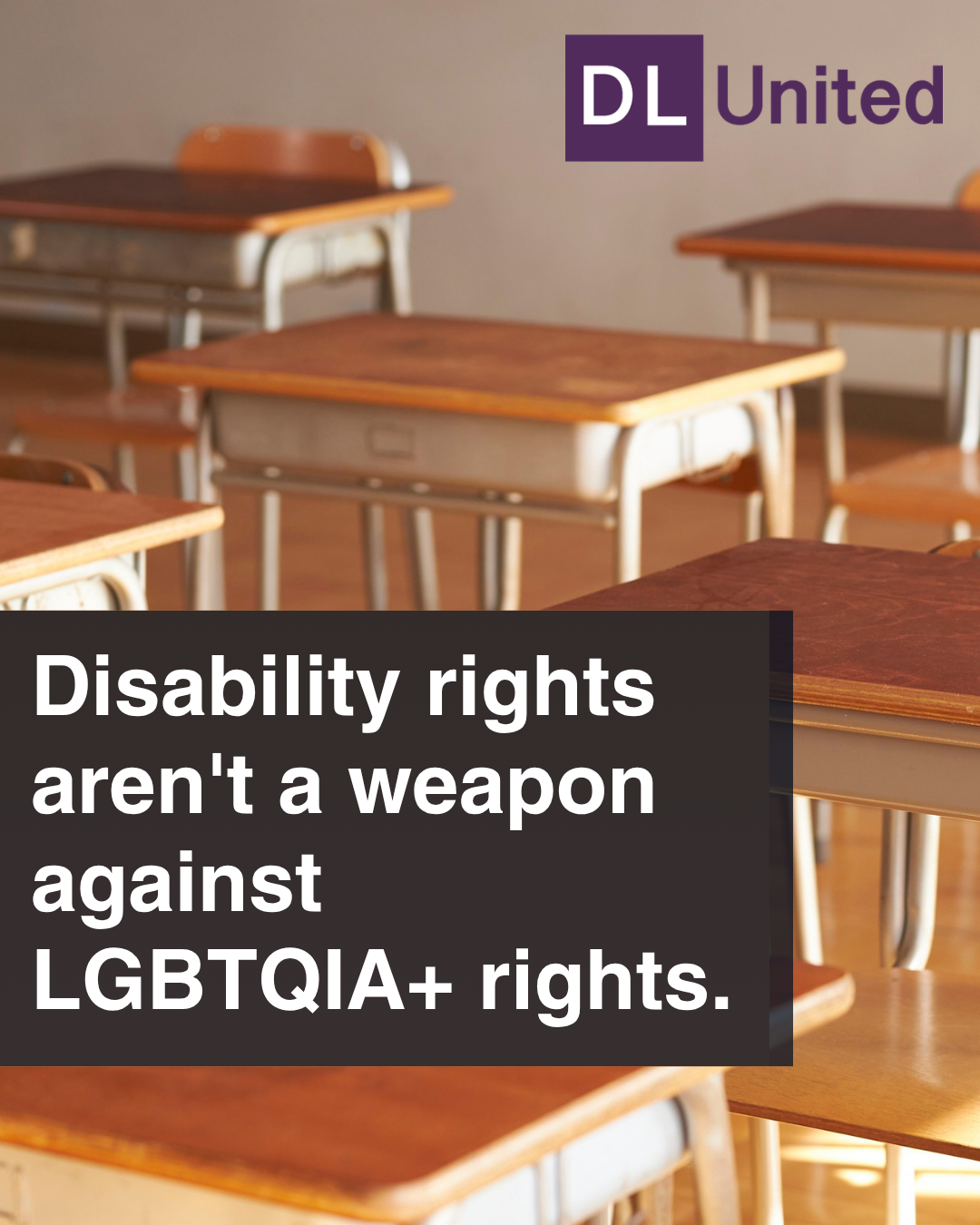
Disability rights and LGBTQIA+ rights are not in competition. That’s the message Disability Law United sent to the U.S. Supreme Court this week, joining DREDF and eleven other disability rights organizations in an amicus brief filed in St. Mary Catholic Parish v. Roy.
What the case is about
The case centers on Colorado’s Universal Preschool (UPK) program, which provides public funding for preschool while requiring participating schools to comply with the program’s nondiscrimination rules. Several Catholic schools sued the state, arguing that UPK’s nondiscrimination requirement unconstitutionally burdens their religious exercise. The schools want access to UPK funding, but also want to be able to deny enrollment to LGBTQIA+ children and families – something the program’s nondiscrimination requirement does not allow.
Where disability rights come in
To make their case, the schools pointed to a different part of the UPK program: a provision that lets schools reserve enrollment spots for children with Individualized Education Programs (IEPs). That provision helps ensure that when UPK’s enrollment-matching algorithm places children in schools, disabled children actually end up somewhere that can deliver the services they’re legally entitled to under the Individuals with Disabilities Education Act (IDEA).
The schools argue that reserving these spots amounts to discrimination against nondisabled children, and use that argument to bolster their broader claim that the UPK program’s nondiscrimination framework is unconstitutional. In other words, they are using a protection designed to secure disabled children’s access to required educational services as a legal tool to justify discriminating against LGBTQIA+ families.
Why this matters beyond one case
This argument, if accepted, would reach far beyond Colorado’s preschool program. Accommodations like Braille materials, sign language interpreters, or extended testing time is what makes equal access to education possible for kids who need them.
The Tenth Circuit Court of Appeals, which previously heard this case, already rejected this line of reasoning, calling it “farcical.” Our brief asks the Supreme Court to do the same, and explains why treating disability accommodations as a weapon against another civil rights protection is both legally and factually wrong.
As DLU Legal Director Cynthia Rice puts it, “Defending long-standing protections for students with disabilities has sadly become a necessity in these times when attacks on civil rights laws of all kinds are becoming routine. DLU will continue to defend and enforce these protections as our core mission.”
Oral argument in St. Mary Catholic Parish v. Roy is scheduled for November 3, 2026.