For Immediate Release, September 17, 2026
Contact: Patricia Cronin, Director of Development and Communications, pcronin@dlunited.org, 303-532-2475
Contact: Stephanie Cascone, Director of Communications and Marketing, National Federation of the Blind, scascone@nfb.org, 410-659-9314 ex 2244
Blind People Sue Two Massachusetts Horse Ranches and Commonwealth Licensing Agency Over Exclusion from Guided Trail Rides
Ranches discriminate against blind riders and receive segregation guidance from the Commonwealth
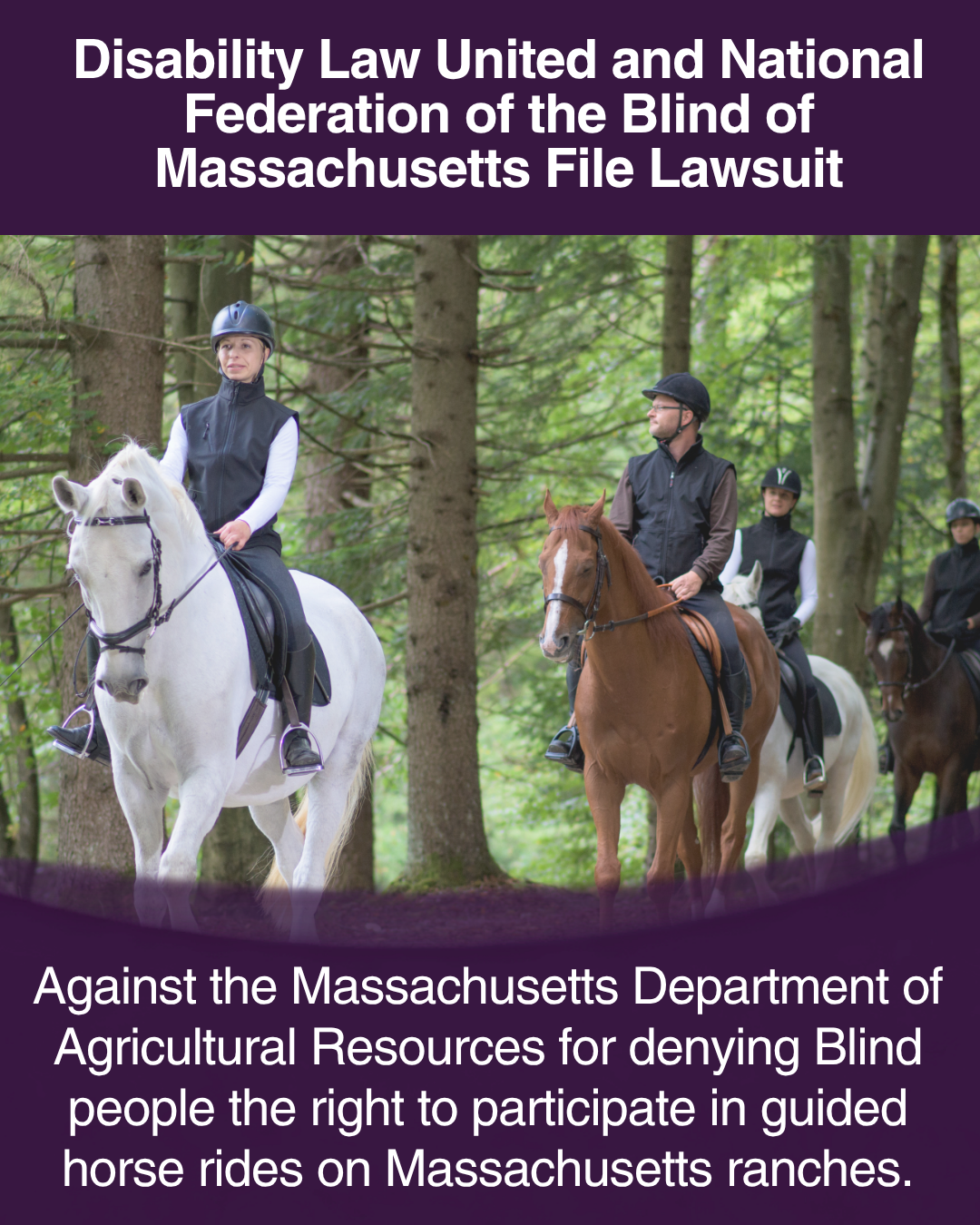
BOSTON, Mass.— Disability Law United filed a lawsuit today on behalf of The National Federation of the Blind of Massachusetts against the Massachusetts Department of Agricultural Resources (MDAR) and two of its licensee horse ranches, Cornerstone Ranch in Princeton and Bobby’s Ranch in Westford, after the ranches refused to let two blind riders participate in guided trail rides solely because they were blind, relying on assumptions about blindness rather than an individualized assessment of their ability to participate.
The two excluded riders who are Federation members, Elizabeth Lesperance and Mika Pyyhkala, are also plaintiffs, along with Lesperance’s best friend Aislinn Brooks.
MDAR is responsible because it tells ranches they will lose their licenses if a Blind person is injured while participating in a guided trail ride. As a result, ranches refuse to let Blind people ride.
The case, filed in the Superior Court of the Commonwealth of Massachusetts, in Suffolk, Case Number: 2684CV02802; alleges Violations of the Americans with Disabilities Act and Massachusetts anti-discrimination, civil rights, and consumer protection laws.
Elizabeth Lesperance and Mika Pyyhkala each tried to arrange guided trail rides for themselves, with Elizabeth hoping to ride alongside her best friend, Aislinn Brooks. When they told the ranches they were Blind, they expected to be asked how the ranches could accommodate them.
Instead, they were refused rides and were told to go to a therapeutic riding program for the disabled. It was only after they sent demand letters explaining the law and seeking to be allowed to ride that they learned MDAR instructed ranches to steer Blind riders toward therapeutic programs and warned that ranches could lose their licenses if a Blind person was injured while riding.
Quotes from Plaintiffs
“I regularly ski, run road races, and take fitness classes alongside everyone else, yet I was turned away from a trail ride solely because I am Blind,” said Mika Pyyhkala. “This case is about more than horseback riding—it is about the basic civil right of Blind people to participate fully in society. Equal access is not a favor, and businesses should not be allowed to exclude us based on stereotypes or assumptions about blindness.”
“I am participating in this lawsuit because I reject the idea that guided trail rides are unsafe simply because a rider is Blind,” said Elizabeth Lesperance. “Vision is not required to enjoy a guided trail ride, and assuming that a Blind rider creates greater risk is discriminatory and diminishes the abilities of Blind people.”
“I am participating in this lawsuit because I witnessed firsthand the hurt and heartbreak my best friend experienced when we were denied the opportunity to participate in a trail ride together simply because she is Blind,” said Aislinn Brooks. “What should have been a special experience became incredibly painful for both of us, and even now, promotional emails from the ranch serve as an unwelcome reminder of what happened. I am also harmed by being denied the opportunity to enjoy activities with my friend simply because she is Blind. I am standing with my best friend because no one should be made to feel excluded or less deserving because of a disability.”
“We tried to educate the ranches on their obligations,” said Al Elia, Senior Staff Attorney at DLU and lead counsel on the case. “We tried to work with MDAR to address their complicity. We were rebuffed. As a Blind person who has taken several guided trail rides outside of Massachusetts, I knew DLU had to make sure the Commonwealth welcomed Blind riders and didn’t segregate them.”
“The National Federation of the Blind of Massachusetts stands with our members to affirm their right to equal participation in all aspects of life,” said Shara Winton, President of the National Federation of the Blind of Massachusetts. “Blind people in Massachusetts have the same right to participate in recreational activities as other members of the public, including guided equestrian trail rides. We are also entitled to have the government affirm that right, rather than suggest that we should be segregated into alternative recreational activities.”
About Disability Law United
Founded in 2013 as the Civil Rights Education and Enforcement Center, Disability Law United (DLU) is a national nonprofit legal organization advancing disability justice through an intersectional lens. Grounded in the Americans with Disabilities Act and the Rehabilitation Act, DLU combines systemic-change litigation, direct legal services, public education, coalition and policy work, and technical assistance to movement leaders to dismantle barriers facing disabled people — with a focus on access to public services and spaces, disaster and environmental justice, immigration, and incarceration and policing. Learn more at www.disabilitylawunited.org.
About the National Federation of the Blind of Massachusetts
The National Federation of the Blind of Massachusetts defends the rights of its members and all blind people in the state and is an affiliate of the National Federation of the Blind (NFB). The NFB is the transformative membership and advocacy organization of blind Americans with affiliates, chapters, and divisions in the fifty states, Washington DC, and Puerto Rico. We believe in the hopes and dreams of blind people and work together to transform them into reality. Learn more about our many programs and initiatives at nfb.org.
Read the full complaint here: